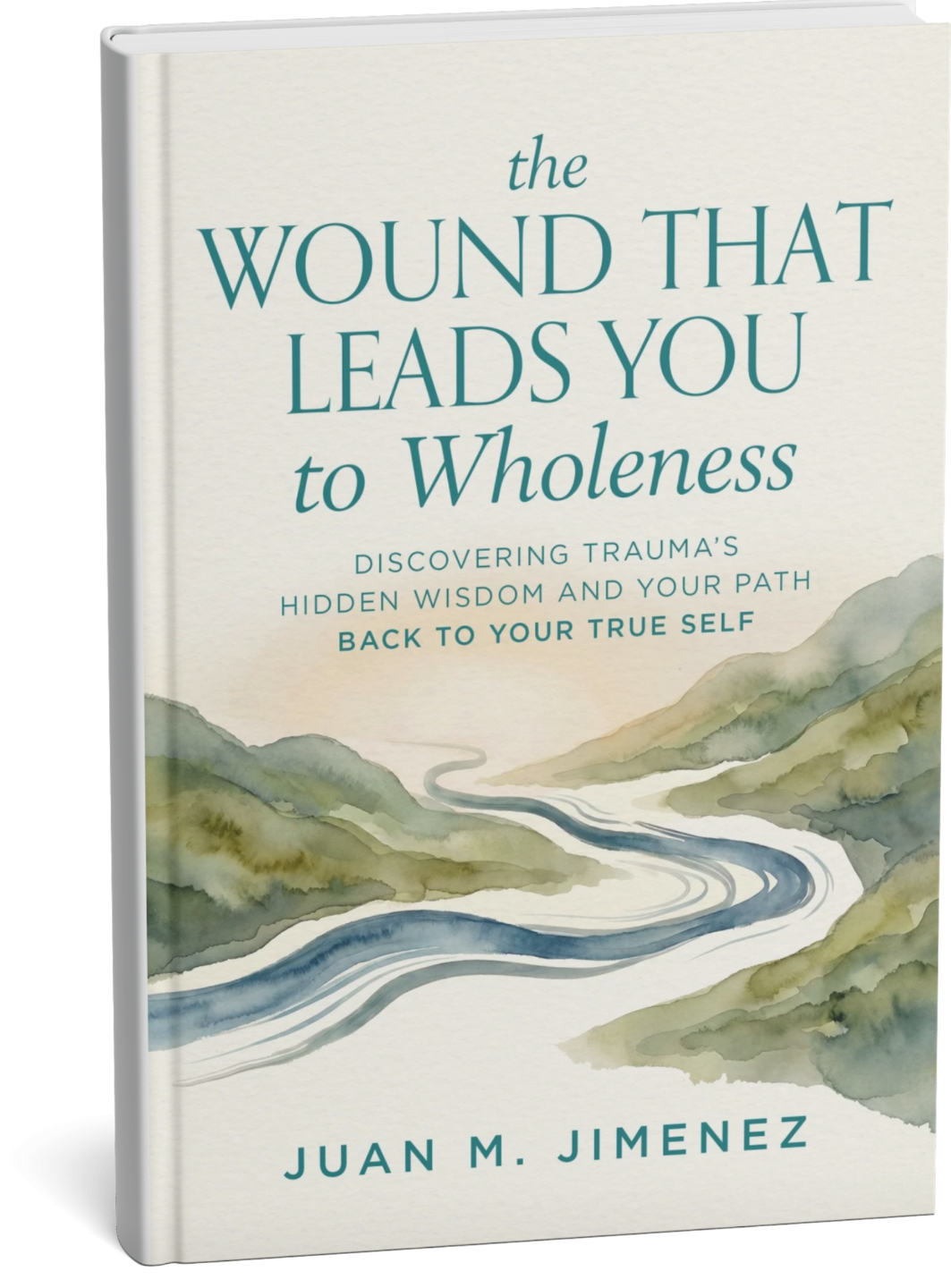

Something in you has been trying to tell you something for a long time.
You have called it anxiety. Depression. Anger that arrives without warning. The inability to stop. The inability to start. The hollow feeling behind a life that looks fine from the outside.
What if it was never the enemy?
This book is built on one of the most misunderstood truths in human healing: that trauma first protected you by disconnecting you from who you really are — and that the pain it left behind is not a malfunction. It is a messenger. It has been pointing you somewhere all along.
About the Book
Every human being has been wounded. Not just some of us — all of us. Because none of us had perfect parents, and none of us live in a perfect world, every person carries some version of emotional injury: unmet need, unheard voice, unprotected vulnerability, or love that came with conditions.
That is not a pessimistic starting point. It is the foundation of the most hopeful journey there is. Because if the wound is universal, so is the capacity for healing.
The Wound That Leads You to Wholeness introduces the WiseRiver Wholeness Pathway — a framework built on a simple but transformative recognition: trauma operates in two layers. First, as a protector — disconnecting you from your authentic self at exactly the moments when staying fully present would have been too dangerous. Second, as a messenger — using the pain left behind to signal the way back to what had to be set aside in order to survive.
The book moves through three stages — Awareness, Authenticity, and Wholeness — not as a straight line, but as a spiral. Healing rarely moves in clean sequence, and this book never pretends otherwise. You may find yourself fully whole in one part of life and just beginning to see clearly in another, and that is not failure. That is how real healing works.
Drawing on more than a decade of frontline work with complex trauma, intergenerational pain, addiction, grief, depression, anxiety, and community healing, author Juan M. Jimenez writes not as a clinician observing from a distance, but as someone who has walked this terrain himself. The book weaves his own story throughout — alongside nine composite portraits drawn from real healing journeys — so that every concept lands not as theory, but as lived testimony.
This is not a book about becoming someone new. It is a book about remembering someone real.
A Different Way of Understanding Your Pain
You will not be asked to fix yourself. You will be invited to understand yourself.
This book treats your coping mechanisms — even the ones that frustrate you — with respect, not diagnosis. They were never evidence that something is wrong with you. They were intelligence, doing the only thing it could do at the time.
Nature is not decoration here. It is evidence.
Throughout the book, patterns from the natural world — rivers, trees, coral, forests, tectonic pressure, seasons — are woven directly into the argument. A tree does not die in winter; it sends its life force underground to protect what matters most. The same intelligence operates in you. These are not metaphors added for beauty. They are structural echoes between how living things heal and how you are healing too.
Compassion runs in both directions.
This book addresses intergenerational pain without placing blame. The same compassion extended to the wounded child is extended to the parent who was once a wounded child themselves. Pain travels through families not through malice, but through survival logic — and naming that clearly is part of how the cycle finally loosens.
It knows its own boundaries.
Not all suffering is a message waiting to be heard. Some pain requires medical, psychiatric, or specialised care that no book can provide. This book is honest about that line — because trust is built by knowing what something is not, as much as by what it is.
This Book Was Written for You If —
- You have lived through experiences that left their mark, whether or not anyone ever called them trauma.
- You sense that something real in you has been buried under everything survival required.
- You are tired of coping strategies that manage the surface while the roots stay untouched.
- You have already done meaningful healing work, and still feel something essential remains unreached.Yo
- u want a framework that honours the full weight of what you have lived — not a shortcut past it.